Why Meeting Agendas Put Questions in an Order
Why meeting agendas put questions in an order becomes clear when you can tell what a public item is meant to do—and what decision, if any, follows.
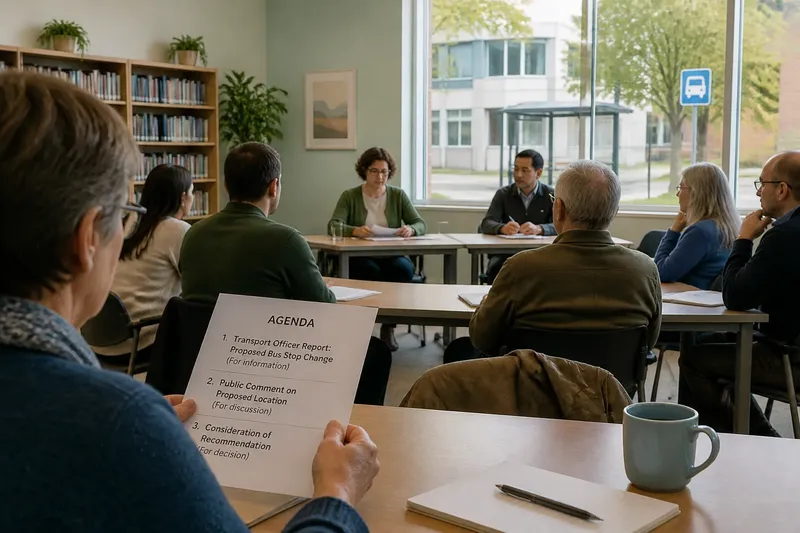
At a library branch, a resident unfolds a printed agenda while the chair is still finding the right page. The first item is a report on a proposed bus-stop change; much later, the council is due to decide whether to approve it. Why meeting agendas put questions in an order is not a puzzle of paperwork: sequence can show what the room is doing now, and what it is not yet being asked to do.
A proposal takes shape
Imagine a clearly hypothetical situation: a neighbourhood council is considering a bus stop move from outside a clinic to a safer, better-lit corner. Residents have raised concerns about the walk, the transport officer has prepared a short report, and the council has authority to recommend a change. Nothing has been decided.
The clerk places three related items on the agenda. First comes the officer’s report, marked “for information”. Next is public comment on the proposed location. Last is “consideration of recommendation”, where members may vote. That order gives the report a chance to supply shared facts before people speak, and gives the council a chance to hear those views before acting.
An agenda works a little like a tray with separate compartments: a document, a discussion and a decision can sit beside one another without becoming the same thing. The labels matter as much as the order. “For information” usually signals that members are receiving material, not being asked to approve it. “For discussion” invites questions or views; “for decision” signals that an authorised body may take a formal action.
What order can show
Related items are often grouped so that a meeting can build towards a useful question. A report may establish the options. Public comment may reveal practical concerns. A later item can then ask whether to accept a recommendation, request more work or defer the matter. The sequence makes the meeting’s intended progression easier to follow.
But order is not a promise. An item appearing near the end does not necessarily mean it is less important, and a report appearing first does not make its contents settled policy. The agenda is a plan for deliberation, not a verdict. Members may ask for clarification, amend a proposal, postpone action or discover that the body lacks authority to decide.
In the imagined council meeting, the officer’s report says that moving the stop would require input from the transport authority. Residents then describe how the proposed corner is used after dark. When the recommendation comes up, a member asks whether the authority has assessed lighting. The council votes to request that information before making a recommendation. The item has produced an observable result—more information is requested—but not approval of the move.
Reading the item label
Before attending or watching a meeting, look for the wording attached to each item. “Receive”, “note” or “presentation” often points to information-sharing. “Discuss”, “consider” or “review” may allow deliberation without requiring a vote. “Approve”, “adopt”, “appoint” or “authorise” more clearly indicates a proposed decision. These words are clues, not universal rules; local procedures and the agenda’s explanatory notes matter.
Also look for a recommendation, a named decision-maker and any attached report. A report may set out options without endorsing one, or recommend a specific course while leaving the final choice to members. A public comment period may invite residents to speak but not give them a vote. Distinguishing these functions helps you prepare a relevant question rather than expecting every agenda item to end in a resolution.
For the fictional bus-stop proposal, a resident who wants to discuss evening visibility might note the report’s stated location and ask whether lighting has been assessed. That question fits the information gap exposed by the sequence. It does not assume the council can itself move the stop, nor that public comment automatically determines the outcome.
When the sequence shifts
Agendas can change in practice. A speaker may be delayed, a report may arrive late, or members may agree to take an item earlier. The chair may also separate a broad subject into smaller questions. If the order changes, listen for an announcement of which item is now being considered and whether the meeting is receiving information, debating a proposal or taking a decision.
In the invented situation, suppose the transport officer cannot answer the lighting question because the authority’s assessment is still pending. The chair could ask members whether they want to postpone the recommendation. If they agree, the item’s purpose changes from deciding on a proposed recommendation to deciding whether to wait. The agenda’s original order has still helped the audience understand why that procedural question arose.
Questions readers ask?
Does every agenda item lead to a vote?
No. A presentation, report or public comment item may be included to inform discussion without asking members to vote. Check the item wording and any recommendation to see whether formal action is proposed.
Can a public meeting change the agenda order?
Often, a chair or members can rearrange items under the body’s procedures, but the rules vary. Listen for the change and note whether the item’s stated purpose remains the same.
What does “for information” mean?
It generally means the material is being presented for members to receive or understand, rather than for approval at that point. A later agenda item may still ask the body to act on the subject.
Where can I find what was decided?
Look for the meeting minutes, decision record or published resolutions, which may appear after the meeting. Compare them with the agenda: the minutes show what happened, while the agenda shows what was planned.
Follow the purpose
When reading an agenda, trace each item’s purpose: what information is being supplied, what question is open, and who can act on it? For the hypothetical bus-stop discussion, that means separating the officer’s report from residents’ comments and the council’s possible recommendation. This simple reading habit makes the sequence legible without mistaking an invitation to discuss for a decision already made.
Keep the agenda beside the minutes if you follow the issue over several meetings. A postponed decision may return with new material, or a request for further work may lead to a narrower proposal. In that next meeting, the order can tell you whether the institution is still learning about the question or is finally ready to answer it.